Sunday, October 23, 2011

Stellar Properties from Afar

Acknowledgements to Eric, Tommy


How many 100W light bulbs would it take to match the power output of the Sun?  I asked a number of non-astrophysics friends here at Caltech for an estimate.  Most gave a guess in the trillions, with a couple people guessing less and a few guessing more.  Let's find out.

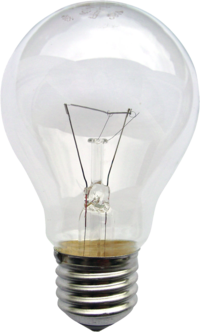
Let's begin by finding the luminosity of the sun.  Luminosity is power.  No, that's not some slogan out of a George Orwell novel, it just says that luminosity is the energy output of a star in a given amount of time - power.  We can estimate the Sun's luminosity using no more than a 100W light bulb and our sense of temperature.  Using these resources, we discover that we have to hold our hand at about 5 cm away from the bulb for the temperature to feel comparable to a hot day.  Using this measurement, we can set up the following proportion and calculate the Sun's luminosity,


where L is the luminosity.  Also note that we multiplied the 100W power of the bulb by 0.1, which is the efficiency.  100W is the input power, but the bulb itself only outputs about 10W.  Also, since the temperature felt at a given distance from a luminous power source is dependent on flux, we square the distances in the denominator.  From this proportion, we calculate the Sun's luminosity to be on the order of 10^26 Watts.  That's a lot!  This means that it would take 10^25, or 10 million billion billion bulbs (each with the 0.1 efficiency) to shine as brightly as the Sun.


What other properties of the Sun can we calculate from the luminosity?  Here are just a couple.


Surface Temperature
Using the luminosity of the sun, we can calculate the flux at the surface by dividing by the Sun's surface area.


Using the Sun's actual luminosity, we calculate the flux at the surface to be 6.3E10 ergs/cm^2/s.
Assuming the Sun is a blackbody, we can calculate the surface temperature using this handy dandy formula.


We calculate an effective temperature of 5780K.


Solar Constant
The Solar constant is the flux of the Sun measured at the Earth.  Using the above formula for flux in terms of luminosity, we can calculate the Solar constant if we replace R with one astronomical unit.  We get 1.4E6 erg/cm^2/s.

Radiative Transfer: Nuclear Winter on Caprica

Second Author - Eric

Abstract
Caprica is a fictional Earth-like planet.  N bombs are dropped randomly across the surface of the planet, each sending a mass M of particles into the atmosphere, each with density ρ and radius r.  Our goal is to find out how this affects the surface temperature and habitability of the planet.

Methods
Let's begin by finding the total number of particles, Np ejected into the atmosphere of Caprica.  We calculate this by dividing the total mass ejected by a single bomb, M, by the mass of the individual particle, given by the product of its density and its volume.  We then multiply by N, the number of bombs dropped across the surface of the planet.  We get the total number of particles to be:


Next, we need to determine what fraction of the total flux at the surface of the planet is blocked by the particles in the atmosphere.  Provided that the particles are sufficiently large and that the thickness of the atmosphere is negligible, we can do this by multiplying the number of particles, Np, by the area of each of them to get the total area blocked by the debris, which is:


We divide this area from the total area under sunlight to get the fraction of the flux that is blocked by the particles, and then subtract from 1 to give us the fraction of light that makes it through to the surface of the planet,


where R is the radius of Caprica.

Now, we can use the equation


to determine how the surface temperature of the planet is affected by the debris in the atmosphere.  We determine that the new temperature is given by the following expression:


where T is the normal average temperature of the planet, or about 287K.

Let's now plug values into this expression and calculate the new temperature of Caprica.
Using N = 5000, M = 10E10 kg, r = 0.1 mm, and ρ = 1000 kg/m^3, and assuming that all other values are the same as Earth, we get that the new surface temperature is 276K.

Conclusions
How hospitable would Caprica be at its new temperature?  276K is almost at the freezing point of water, and considering the economic and agricultural effects of such a temperature shift, there would likely be a mass extinction as a result of the nuclear winter (radiation aside).

Tuesday, October 18, 2011

Determining the Astronomical Unit from Mercury's Transit and Period

Acknowledgements to Eric and Daniel


We will determine the astronomical unit (the distance between the Earth and Sun) using Mercury's period with a time series of images of the transit of Mercury across the Sun taken by NASA's TRACE satellite.

In the image above, the blue circle is the Earth, the grey circle is Mercury, the yellow circle is the Sun, and the pink circle is TRACE.  The red lines are drawn from TRACE (at the two different points shown), through the center of Mercury, to the surface of the sun.  The green lines are drawn from TRACE to the apparent center at the surface of the sun.  The white line divides the diagram symmetrically.  Three angles are labelled (αβ, and ɵ), as well as the distance between Earth and Mercury, Δa.  

Using basic geometry, we can state the following:
ɵ = α + β


Using trigonometry, this becomes
(Earth Radius)/Δa = α + (Earth Radius)/a   (a being the astronomical unit)
assuming that the distance between TRACE and the surface of the Earth is negligible.


This can be simplified to the following:
*α=(Earth Radius)(1/Δa - 1/a)


Looking at the image of the transit above, we can see Mercury crossing with a sinusoidal path.  This is the result of parallax, given TRACE's polar orbit.  Geometrically, we can state that the ratio between this path's amplitude and the radius of the sun is equal to the ratio between our angle α and the angular diameter of the Sun (about half of a degree).


After gathering extremely precise measurements of the aforementioned amplitude relative to the radius, we can calculate α = 4e-5 radians.


In addition, using the relationship between the period of a planet and the distance from the Sun,
We can calculate the ratio between a and (a-Δa).  Doing the math, we then get that Δa=0.62a.

Substituting this and our value of α into the asterisked equation from above, we calculate the astronomical unit a to be 9.7e7 km.

This is quite close to the actual astronomical unit, which is 1.5e8 km.


Friday, October 7, 2011

Local Sidereal Time and the Celestial Sphere

Second Authors (in no particular order):  Eric, John, Mee, Daniel

When astronomers study celestial bodies, it is important to find them in the first place.  Fortunately, there is a coordinate system that allows them to do so.  Let's define the coordinates.

Wikipedia
Celestial Equator:  As the name suggests, the celestial equator is the equator of the celestial sphere.  It is a projection of the Earth's equator into space.
Right Ascension (RA):  The right ascension is the first of two coordinates of the equatorial coordinate system and is the equivalent of longitude on the celestial sphere.  It can be measured as an angle, or on a 24 hour timescale (00:00 to 24:00 instead of 0 to 2π).  Starting at the Meridian (the line perpendicular to the celestial equator that the sun crosses at noon on the vernal equinox), the RA increases eastward.
http://upload.wikimedia.org/wikipedia/en/a/a6/Sidereal_Time_en.PNG
Declination:  The other coordinate, the declination is the equivalent of latitude and is measured in degrees north or south of the celestial equator.


Sidereal vs Solar Time
When one is asked how long a day is, the typical answer will be 24 hours.  This is approximately the length of a mean solar day, which is the apparent time it takes the sun to circle the celestial sphere.

When mapping distant stars, however, using solar time becomes problematic, since it appears to take about 4 minutes less for other stars to circle the celestial sphere.  As such, objects outside our solar system follow what is called sidereal time.  Instead of 24 hours, one sidereal day is about 23 hours, 56 minutes long.  The 4 extra minutes of a solar day are due to the fact that the earth revolves around the sun.  The local sidereal time (LST) the current right ascension of the meridian, and is 00:00 at noon on the vernal equinox.  How do we calculate the LST throughout the year?  Let us examine this with some examples.


To find the LST at midnight on the vernal equinox, we add 12 hours to 0:00.  The LST is thus 12:00.

What is the LST 24 hours after the vernal equinox?  00:00 + 24:00 gives us an LST of 00:04.

What is the current LST?  I am writing this at about 1pm (20:00 UT) on Friday October 7, 2011, which is 4832 hours after the vernal equinox, or 201 sidereal days + about 21 hours.  Thus, the LST at the moment is about 21:00 in UT, or 05:00 in PST.  The LST at midnight tonight will be 11 hours later, making the LST 01:00.


The differences between solar and sidereal days account for the apparent annual "rotation" of the celestial sphere.

Monday, October 3, 2011

Astronomy vs Art. Are they really independent of each other?

Many consider science and art to be separate and distinct.  Science is based primarily on logic, and art is mainly based on creativity, right?  Is there really an art to be found in astrophysics?  Most definitely!

The first thing that comes to mind is the visual beauty of nature.  When you ask people about space, many will immediately think of the picturesque galaxies photographed by telescopes like Hubble, such as Arp 273 in the image below.


I often like to say that space is the best art gallery out there (it's free, too), and that Hubble is the new Ansel Adams.  But how else is science artistic?  Sure, galaxies are pretty, but is that it?  The short answer is no.

The long answer is that the physical laws governing the cosmos have beauty, themselves.  The fact that something as simple and indifferent as gravity (or as mind-blowingly complex as gravity if you're someone who works with general relativity) can create such magnificent structures is pretty awesome.  The fact that most of the atoms within us originated in the cores of stars is really awesome.  The fact that a sack of organic molecules on a tiny speck of dust rotating around a modest clump of burning gas can calculate the properties of a quasar billions of parsecs away and billions of years in the past is so incredibly awesome that one cannot fully describe it in words.

So nature and the laws that govern it are quite spectacular.  But where's the creativity come in?

"Imagination is more important than knowledge" ~ Albert Einstein

Imagination and creativity are what drive scientists to explore the limits of knowledge.  Since one cannot claim knowledge of what lies in the realm of the unknown (this may seem incredibly obvious, but many treat assumptions as fact), one can only work with imagination to move forward.  The spark behind every hypothesis is a "what if" or "imagine if" question.  What if the Earth orbited the Sun?  Imagine if humans and other apes evolved from a common ancestor.  It is easy to see how the science depends on imagination and creativity just as much as it depends on current knowledge.  Generally, the scientific method consists of the following three stages.

Observation and Questioning
Let's imagine that an individual named Specimen A is looking at a ship sailing into the open sea.  Using binoculars, they will observe that the ship appears to eventually "sink" below the horizon.  "Why does this occur?" asks Specimen A.  The ship couldn't be sinking, since it eventually returns.

Imagination and Prediction
Specimen A ponders the question and stumbles upon a creative solution - a curved Earth, or perhaps even a spherical Earth.  If this were true, then the sinking illusion would be a result of the ship sailing "over" the horizon.  Given the public knowledge of the time, the other specimens would find this suggestion preposterous.  The horizon appears flat!  Surely they know that the Earth can't be curved.  Eager to test this hypothesis, Specimen A imagines what a spherical Earth would mean.  If this were the case, Specimen A could embark on a voyage westward and eventually return from the east.

Experimentation and Obtaining Knowledge
Specimen A sets sail on their boat and travels west.  Surely enough, after sailing around a few continents, they return to Location 1, where they began.  Specimen A just discovered that the Earth is round!

A ship sailing over the horizon

Ultimately, science is a creative and imaginative process of testing the limits of knowledge and uncovering reality bit by bit.  It is, in essence, an art of discovering the natural world.
Measuring the radius of the Earth at the beach


We begin by lying down on the ground.  When the sun hits the horizon, we start the stopwatch and stand up, making the sun appear above the horizon again.  When it hits a second time, we stop measuring.  Among our measurements, all were around 10^1 seconds.  Using this value, we calculate the angle to be 7.2e-4 radians.  Setting our hight at 6 feet, we calculate the radius of the Earth to be 2.3e7 feet, or about 6900km.  The actual radius of the Earth is about 6400km.  Error was likely due to human reaction time, as well as the atmospheric effects that made it difficult to see when the sun hit the horizon.

Wednesday, September 28, 2011

Perspective

In our busy day to day lives, it's difficult to truly imagine the scale of things in the universe.  From our perspective, the earth is a flat, stationary center of the universe, and all of the celestial bodies seem to revolve around us.  In fact, this was what humanity believed for many centuries.  Upon observing the sky, however, we gained a completely new view of the cosmos.  The Earth is actually round and revolves around the sun in an elliptical orbit, just like the 7 other planets (sorry, Pluto).  In addition, Earth is rather small compared to its siblings, which themselves are tiny compared to the Sun.
The distances between the planets, however, are even more immense.  Jupiter, the largest planet, appears as a dot in the night sky, and the Sun, capable of holding over a million Earths within its volume, can be covered by your thumb held at arm's length.  Once we leave the solar system, though, distances become even larger.  Our nearest star, Proxima Centauri, is over 4 ly away.   The nearest galaxy is thousands of light-years away.  It is clear that our solar system, our galaxy, and the universe mainly consist of emptiness.

Many find these distances frightening or saddening, but astronomers find them fascinating and enlightening.  The Earth is perhaps no more than a negligible speck, floating in the middle of nothingness amongst billions of other planets, revolving around billions of stars, in billions of galaxies.  But despite the insignificance of humanity in time and space, we've managed to discover so much about this enormous universe within a few hundred years.  And there's even more to be discovered.

I'll finish this blog post with a video that I put together about a year ago during winter vacation.
Narrated and written by Carl Sagan.